

Stuck in a cycle of anxious thoughts? These questions can help
Plus: Why some people are mosquito magnets + What’s a “prebiotic”?

Welcome to Doing Well. Today:
An interview with tools for managing anxiety
Word of the week: prebiotic
Health news we’ve found useful this week
Thanks for reading—let’s get started.
We Asked: How can we manage anxiety?
An estimated 1 in 5 American adults has an anxiety disorder, making anxiety disorders the most common mental illness in the U.S. Having an anxiety disorder can be overwhelming, isolating, and all-consuming—at many moments in my life, it has been for me. But anxiety disorders are also treatable, and there are several powerful, evidence-based treatment options, including psychotherapy, medication, and even brain stimulation.
Despite the effectiveness of treatment, though, only an estimated 1 of every 4 people who needs treatment gets it. To understand the roots of anxiety and the most effective ways to tackle it, we spoke to Kate Wolitzky-Taylor, a clinical psychologist, associate director of the Anxiety and Depression Research Center, and professor of psychiatry at the University of California, Los Angeles. Our conversation has been edited for length and clarity.

Short on time? Here’s what to know:
Anxiety is a normal emotion. But when anxiety becomes excessive, persistent, uncontrollable, and it starts to get in the way of someone’s life and cause distress, that could be a sign of an anxiety disorder, and it’s a good idea to talk with a professional to explore options.
There are several different types of anxiety disorders, including social anxiety disorder, generalized anxiety disorder, and phobias.
Cognitive behavioral therapy (CBT) is an effective treatment for anxiety that teaches someone to reassess and restructure inaccurate and unhelpful thought patterns. An important component of CBT is exposure. If someone has a specific phobia, this could mean safely exposing them to the thing they’re afraid of; if their anxiety is more generalized, it might mean asking them to act without “safety behaviors” like repetitively checking something or seeking constant reassurance.
Our thought patterns reflect our experiences and circumstances, and no one is choosing to be anxious. CBT is about developing skills to rewrite thought patterns that aren’t serving us so that we can live happier, more grounded lives.
Mia Armstrong-López: Most of us will feel anxious at some moments of our lives. What is the difference between feeling anxious and having an anxiety condition?
Kate Taylor: Anxiety is a natural, normal, human emotion that we all feel from time to time. It’s our body’s way of protecting us from danger or threat. It’s helping us prepare for and prevent bad things from happening. We need anxiety to some extent. Where it starts to become a problem is when it’s excessive, persistent, uncontrollable, or out of proportion to the threat, and it’s starting to get in the way of our lives.
MAL: It’s helpful to think of those criteria for an anxiety disorder: persistent, excessive, getting in the way of life, causing distress. Are there questions people can ask themselves if they’re wondering where they might sit on that spectrum of normal anxiety versus an anxiety condition?
KT: If you’re concerned, you should get professional assessment and diagnosis. But some things you could be asking yourself are: Am I avoiding things in daily life that most people don’t avoid because of my anxiety or fear that something bad might happen? Is that avoidance preventing me from living the kind of life I need to live or want to live? Is it disrupting my quality of life? Another might be: Am I engaging in unhelpful behaviors to try to alleviate that anxiety? For example, Do I only go into crowded places if I have my significant other with me? Do I drink alcohol before I go into a social situation because I need to calm my nerves? These behaviors might be signs that you want to seek a more formal diagnosis.
One of the most common anxiety disorders is generalized anxiety disorder, and that’s characterized by excessive and uncontrollable worry.
MAL: If someone is diagnosed with an anxiety disorder and wants to seek treatment, there are lots of options. One of the options you’ve delivered to patients and studied is cognitive behavioral therapy, or CBT. What does CBT involve, and how effective is it in treating anxiety?
KT: CBT is considered the first-line treatment for anxiety disorders. Cognitive behavioral therapy is based on what we think in a situation, or in response to some kind of stimulus. It might be: I’m giving a speech to a group of people, and I’m feeling really anxious. What is the thought going through my head? Oftentimes, those thoughts are automatic, and that thought dictates what happens next. If I have the thought when I’m giving a speech, Everyone’s going to think I’m stupid, I’m going to start feeling anxious. My thought is guiding how I feel, it might guide the physiological sensations I feel in my body, and it might guide my behavior.
Another person who’s really confident could walk into the room and have the thought, Everyone’s really excited to hear what I have to say. And they’re going to feel relaxed and happy and excited to give this presentation. Same situation, two different thoughts.

The idea of CBT is to address those inaccurate, oftentimes inflexible and unhelpful thoughts through skills to learn how to think in a more evidence-based, factual way, which then shifts that feeling and behavior cycle.
Some of the really common behaviors we see in anxiety disorders are avoidance, escape—when we’re in the fear situation, getting out of there. That’s our body telling us, there’s danger, you better get out. But in an anxiety disorder, it’s a false alarm.
The other one is what we call safety behaviors: behaviors that people do to try to reduce their anxiety or prevent a negative outcome in that moment—things like taking a friend with them to go grocery shopping, distracting themselves on their phone when they’re feeling anxious. It may make them feel better in the short term, but in the long term, it’s actually keeping their anxiety going, because they’re never giving themselves the chance to see that that situation was actually not dangerous. They start attributing the fact that nothing bad happened to the fact that they used that safety behavior.
What CBT does is it directly opposes those avoidance behaviors. Instead of avoiding situations, we encourage our patients to face their fears. Think of someone who’s afraid of driving. We would have them drive. But it could also be someone’s fear of their own bodily sensations. Someone with panic disorder might be afraid that if they feel their heart race, it means they’re having a heart attack. So we would actually do gradual exposure to exercises that bring on a racing heart, so that they can see that this is just a sensation in their body.
MAL: I was diagnosed with generalized anxiety disorder a decade ago, and one of the things that my mind does is catastrophize: Thinking, Okay, if I can sketch out the worst possible thing that could happen, then I can prepare myself for it. What is the role of catastrophizing, or thinking that you can game through or prepare for worst-case scenarios?
KT: The two most common thinking errors—unhelpful ways of thinking—in anxiety are to overestimate the likelihood of a bad thing happening and to catastrophize. To think that, if it happened, it would just be the worst thing in the world. Cognitive restructuring teaches you skills to reduce that type of thinking.
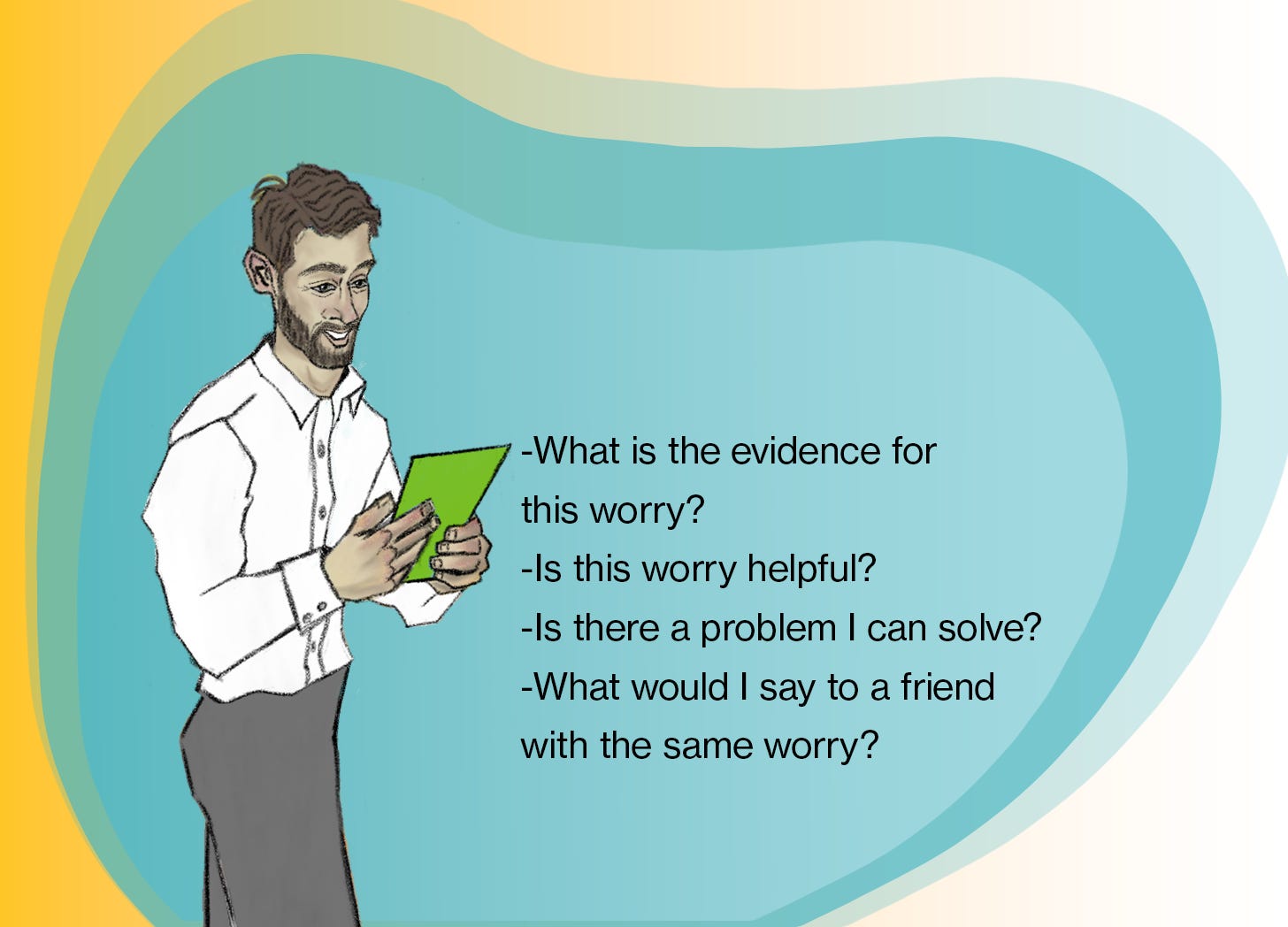
What your question is getting at is something that we call metacognitive beliefs about worry. A lot of people with generalized anxiety disorder believe that their worry serves this great purpose to problem-solve your way out of something. If I worry enough, I will come to a solution, or My worry is helpful because it motivates me to do something. There’s a lot of unhelpful and inaccurate positive beliefs about worry, just like there could be inaccurate and unhelpful negative beliefs about worry—Worrying is so bad, if I do it, I’m going to lose control. That’s also not true, and some people have that belief as well.
What I’m hearing you say is that you have a belief that playing out all the possible scenarios will get you to some “aha” moment where now you’ve prepared. What we do is we use certain therapeutic techniques to help patients explore this idea that your worrying actually can prevent a negative outcome. It can’t. That your worrying is the same as problem solving. It’s not. Those are two different mental processes.
MAL: That’s really helpful, because trying to preemptively solve all of these theoretical problems actually doesn’t make you very good at solving or recognizing the problem that is in front of you, in my experience. You mentioned that exposure is the most important part of CBT. Exposure feels very clear for folks who have a specific phobia. For folks who have more generalized anxiety, what does exposure look like?
KT: I answer this a lot for clinical psychology doctoral trainees, psychiatry residents. Well, they’re just worrying, what could you possibly expose them to? There’s actually a lot you can do. People with generalized anxiety disorder tend to use a lot of safety behaviors. This might look like over-preparing for things, excessively checking, seeking excessive reassurance from loved ones that they’re not mad, not expressing disagreement, apologizing a lot, deferring to what other people want. It’s driven by a fear of, If I do this, someone might get mad at me, or If I don’t check my bank account every day, I’m going to lose all my money, or If I don’t re-read this email three times, I might not catch a typo, and then my boss might fire me. So, we will have people start to fade out those safety behaviors. We can let go of these things, and nothing bad happens. That’s one way of doing exposure.
MAL: I love that. When you’re deep in anxiety, it can feel like, Oh, this is how everyone thinks, or There’s no other path, this is how I will always think. That there are other possibilities is hopeful.
Find resources with the Anxiety and Depression Association of America and the Association for Behavioral and Cognitive Therapies
Well-Informed: Related stories from the ASU Media Enterprise archives
What does mindfulness look like in practice? In this essay for Zócalo Public Square, Dr. Jean Howell writes about how he’s incorporated mindfulness meditation into how he cares for his patients and himself.
Zócalo is now on Substack! Subscribe for direct updates from the outlet that connects people to ideas and each other.
Well-Versed: Learning resources to go deeper
Kids often struggle with stress, worry, fear, and anxiety. COMPASS for Courage is a toolkit, presented by Arizona PBS and developed by ASU, that uses game-based learning to equip them with strategies to manage stress.
Well-Read: News we’ve found useful this week
“What to know about the heat wave headed to the U.S. ahead of Fourth of July,” by Chad de Guzman, June 29, 2026, TIME
“What is cortisol? Your questions, answered,” by Jennifer Gerson, May 26, 2026, The 19th
“Scratching that bug bite might feel good at first but science explains why it’s a bad idea,” by Lauran Neergaard, June 27, 2026, The Associated Press
Well-Defined: Word of the week
Prebiotics are nutrients for probiotics, the useful microorganisms that live in our bodies. Prebiotics come naturally in foods such as wheat and whole grains, garlic, onions, bananas, and soybeans. We can’t digest prebiotics on our own, but our probiotic microbes can. In this way, prebiotics serve as food for the probiotics.
Our microbiomes need both prebiotics and probiotics to thrive. Plus, all prebiotics are fiber, so increasing your prebiotics also brings you the great benefits you get from increasing fiber.
If you’re looking to incorporate more prebiotics into your diet, here’s a place to start.
-Kitana Ford, health communication assistant
Well-Engaged: Why am I a mosquito magnet?
Have you ever heard mosquitoes are more attracted to you because you have “sweeter blood”? There’s no evidence that mosquitos have a sweet tooth. But it is true that some people are more likely to get bitten.
Mosquitos identify a potential nearby victim by detecting carbon dioxide—what we breathe out. The heavier breathing, the more carbon dioxide, and the more attractive target you are for a mosquito. This is why you may have experienced heavy biting during exercise.
Mosquitos are also attracted to sweat. When we sweat, our body gives off a certain mix of chemicals, and even if humans don’t notice them, there are combinations that mosquitos prefer. Perfumes and deodorants can attract mosquitos, as can skin care products.
The color clothing you wear may also have an effect. Mosquitoes seem to like red, orange, and black and dislike green, purple, blue, and white. There’s some evidence that blood type, too, may play a role—in one study, some mosquitos preferred type O blood.
While it’s not possible to change all these factors, there are steps you can take to reduce your risk of getting swarmed. Examples include wearing loose-fitting clothing that covers exposed skin, keeping your yard dry, and using insect repellent.
-Kitana Ford, health communication assistant
Do you have a question or topic you’d like us to ask an expert about? We want to hear from you.
Appreciate the topic. Many don’t yet understand how debilitating anxiety can be. I wished we would have understood it better when my child was younger.