

Looking for a new exercise routine? Start here.
An interview with an athletic trainer. Plus: What's "aphasia"? + How can you get help with the cost of medications?

Welcome to Doing Well. Today:
An interview on safely starting a new exercise routine
Health news we’ve found useful this week
Word of the week: aphasia
How can you get help with the cost of medications?
Happy Tuesday. Let’s get started!
We Asked: What should we know before starting a new exercise routine?
The most common New Year’s resolution is to exercise more—1 in 4 Americans have committed to doing so. While gym membership sign-ups and exercise tracking increase in the first weeks of the year, it can be hard to sustain new habits. Perhaps you’ve noticed your exercise class or local park is full on Jan. 1, and then empties a few weeks later.
This time of year, it can feel like everyone is trying to sell you a new workout routine or “hack”—but building consistent, realistic, and safe exercise habits requires intentional planning. We spoke to Alicia Montalvo, a certified athletic trainer and professor at ASU’s College of Health Solutions, for her pointers on incorporating movement into our routines all year long. Our interview has been edited for length and clarity.
Short on time? Here’s what to know:
Before starting a new exercise program, assess your skills, goals, needs, and current fitness level. Don’t go out too big: You want to gradually increase physical activity so you don’t injure yourself or overload your system. If you haven’t run in a few months, don’t set out for a 10-miler—start slow and work your way up.
There is no one perfect exercise—don’t sign up for a gym membership just because you feel like it’s what you’re “supposed” to do. Ask yourself what movement you enjoy, and what fits into your life. That could be a recreational league, group fitness class, or a walk around your neighborhood.
If you start to feel pain while exercising, don’t push it. That’s your body telling you to slow down.
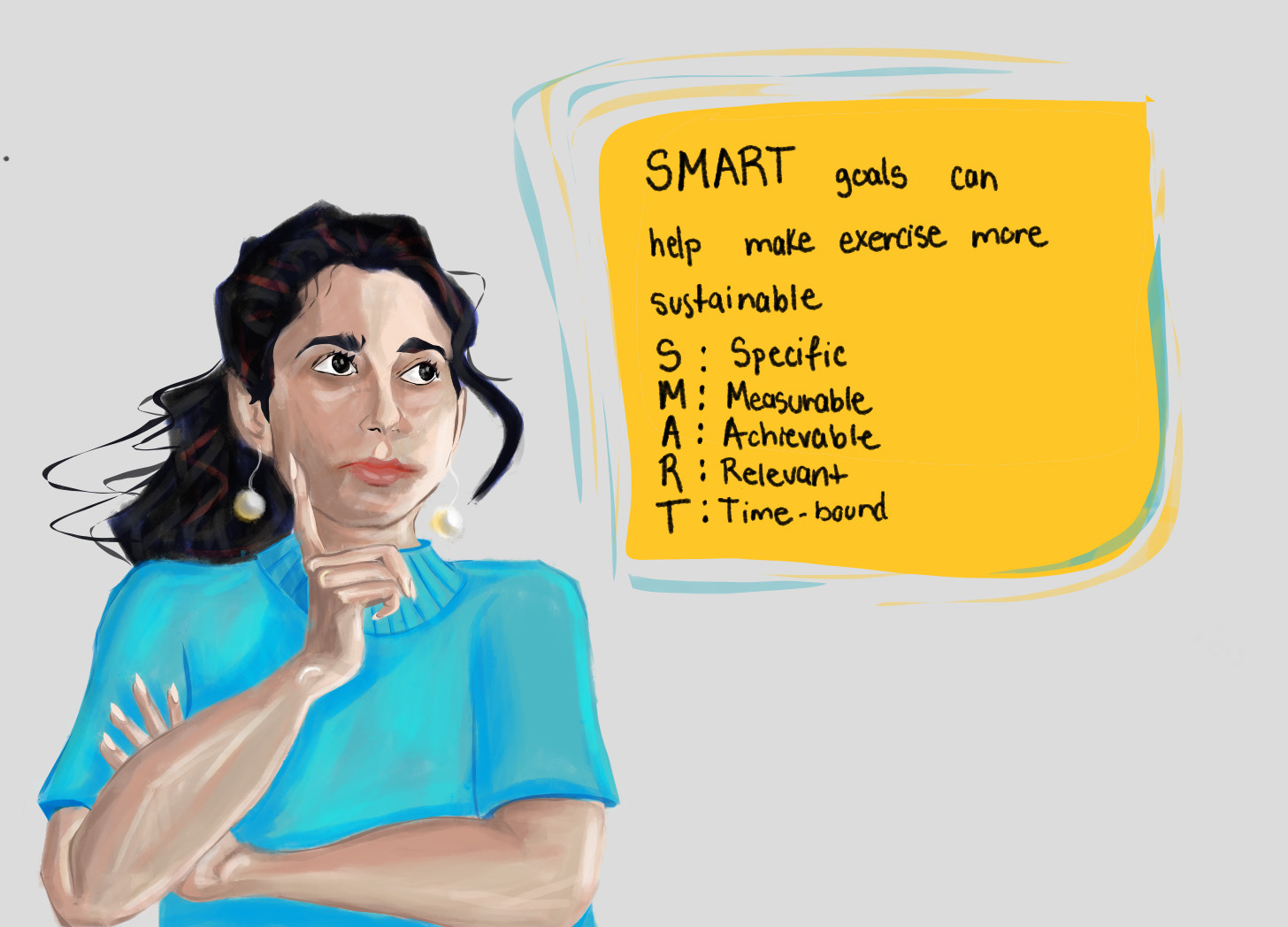
Focus on exercise goals that are specific, measurable, achievable, relevant, and time-bound—these are called SMART goals. Your goals should be focused on a performance outcome, not a body outcome (“use 20 pound weights for a set of 10 squat presses,” for example—not “tone my legs”).
Mia Armstrong-López: This time of year, a lot of people are starting new exercise routines. What should they think through before they do so?
Alicia Montalvo: The first thing that somebody should consider is: What are my current needs, what are my current goals, what is my current skill level, and what is my current fitness level? You really need to take an honest look and say: What physical activity have I been doing? What am I prepared to do?
Take stock of your personal fitness level and your skills and abilities—allow that to guide you. How can you gradually progress your physical activity in a way that you’re not overloading your system, leading to injury? Is there a way that you can modify the activity so that it’s suitable for your fitness level and your skill level? Whatever the activity is, it’s important to gradually progress.
Keep a log of your exercise: which days did I go? What did I do? How much time did I spend at what intensity? If you’re not documenting those things, then it becomes really difficult to say: I’m ready to progress.
MAL: What’s a good way for someone to assess their fitness and skill level, so they can develop a routine that matches?
AM: If you don’t know what you’re doing in the gym [and] you don’t want to participate in group fitness, I would recommend getting a personal trainer who’s got the appropriate credentials and can do an assessment of your needs, goals, and skills. If you’re not able to or you don’t want to do that, you can follow the [American College of Sports Medicine] guidelines.
When you begin physical activity, you want to evaluate: What cardiovascular activity have I been doing? What intensity has it been, and how frequently? Somebody who’s brand new is going to need to start at a very low intensity and work their way up gradually. Somebody who’s been engaged in maybe moderate cardiovascular exercise for 30 minutes a day, three days a week, for the last three months—that person has cardiovascular training and can do a bit more intense work gradually over time. If you’ve been doing high-intensity interval training, you can continue doing that.
For resistance training, it’s a little bit more nuanced. Somebody may have been doing resistance training—maybe they were a college athlete 10 or 20 years ago, and they’re highly skilled in lifting maneuvers, but they haven’t touched any weights since they were in college. So your skill level is different from what you’re capable of doing today. You’d want to consider: How much have I been lifting in the last six months? Have I been lifting two days a week, at least, for the last six months? If I have, then maybe I want to consider progressing to free weights from machines, or from body weight to more intense exercises. Those are the two things to consider: Is my body trained in resistance training? Do I have knowledge and skill in resistance training?
MAL: Do machines provide more structure or support for someone who’s not used to free weights?
AM: Machines kind of force you to have good mechanics when you’re lifting, if you position yourself correctly inside the machine. If you’ve set the seat or hands to the right height, you can really get a good benefit if you’re somebody who’s never done resistance training before. The machines are on tracks, and they don’t require the demand or stability that a free weight or a bodyweight exercise might require.
I would recommend people stay away from single-joint exercises if they’re trying to build strength or grow muscle. You can get more bang from your buck from a multi-joint exercise—anything that requires more than one joint to move at a time.
MAL: Athletic trainers identify who might be more likely to get injured, and what puts them at risk. You mentioned pushing beyond our limits. Are there other factors that increase the risk of injury?
AM: The biggest predictor of injury is past history of injury. The most common injuries are ankle, low back, and shoulder injuries, generally speaking. So, if you’ve had an ankle injury in the past, and you’re going to start pickleball or basketball, you’re probably going to be experiencing an ankle sprain in your near future. If you’re a chronic shoulder dislocator and you pick up tennis, you’re going to be looking at some shoulder instability.
It’s about starting exercise appropriately and grading it appropriately. Any time you’re picking up an activity and you’re moving too quickly, you might get injuries that are very difficult to overcome.
MAL: Are there injury warning signs that people should pay attention to?
AM: First, pain before activity that goes away with activity. So you think, “Oh, I’m just gonna warm up, and that pain is gonna go away.” Then, it’s pain during activity that doesn’t go away after activity or at all. If you feel an indication that there’s pain, it’s probably time to start dialing back. Don’t just say, “Oh, I’ll warm up and it’ll go away.” That’s your body telling you: “We need to dial it back now before it becomes a full-blown injury.”
MAL: Is there a difference between soreness and pain?
AM: Pain will be in a very specific area that you’re probably not used to feeling soreness in. Soreness is associated usually with muscles—that’s an indication that maybe you went a little hard on the resistance training. It’s normal to be sore, it’s not normal to be painfully sore.
With the beginning of an injury, you’ll usually feel the pain in a place that’s not a muscle. You might feel it on a specific part of your elbow, you might feel it on your knee. If you’re feeling pain on the bottom of your foot [or] your shin, where you don’t really have any muscles, [that’s] probably an indication that you’re going too hard.
MAL: How important is stretching to prevent injury?
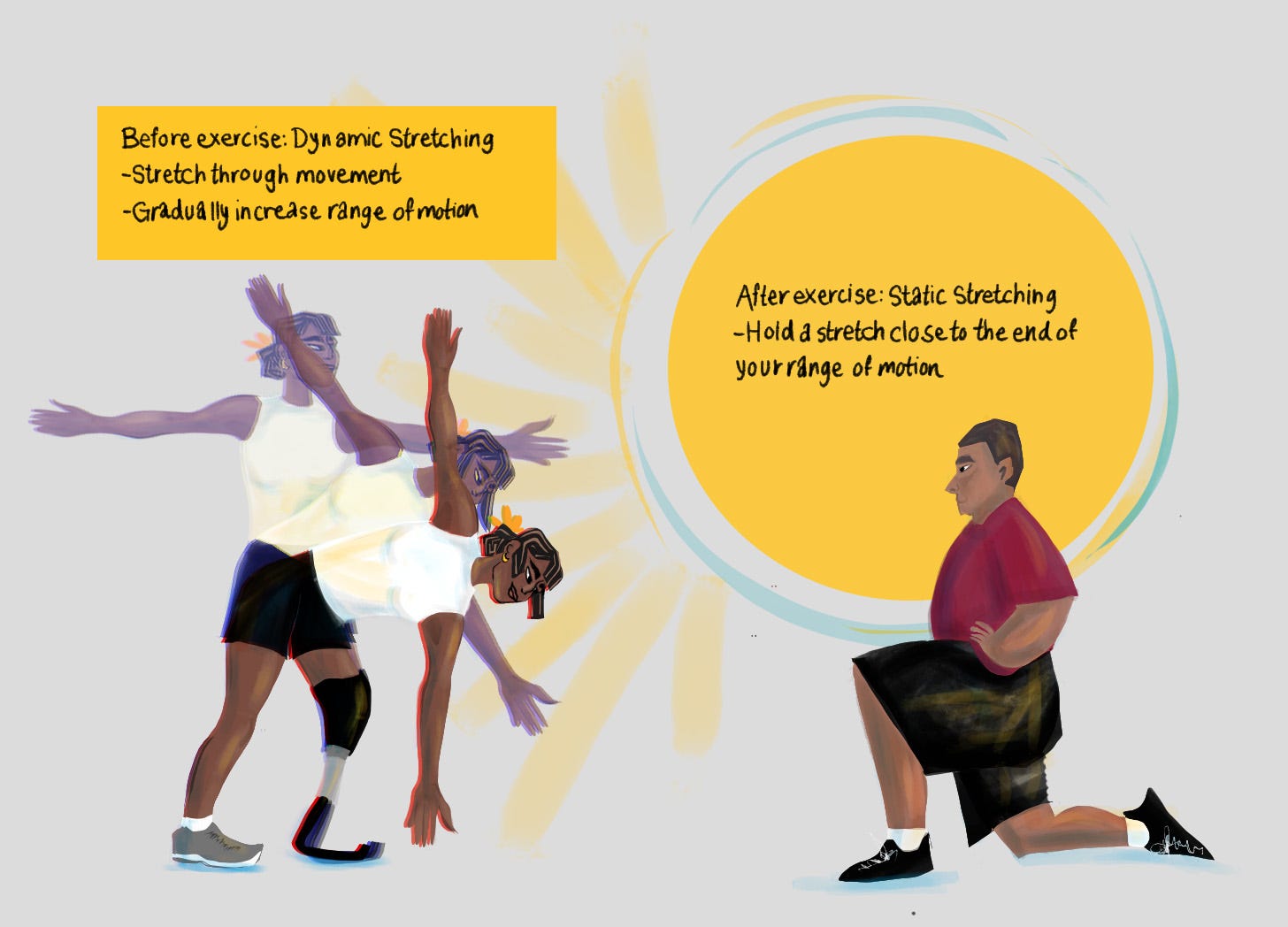
AM: It’s important to include structured warm-ups and cool-downs in an exercise routine, regardless of whether it’s cardiovascular training or resistance training. A structured warm-up should include flexibility exercises. You’re preparing for the exercise, so you do what’s called dynamic stretching—you stretch through movement, and you gradually increase the range of motion that you’re moving your body through.
At the end of a routine, you can do what’s called static stretching, which is the more traditional stretching where you get into the position and you hold closer to the end range of motion. These types of stretches should be slight discomfort. If you’re in pain, you’re probably going too hard. You want to hold for maybe two sets of 30 seconds at that intensity per stretch, per side.
Engaging in stretching over time improves your posture, the way that you’re carrying your body, and then when you put your body under load, if you’re resistance training, or if you’re doing some sort of repetitive activity, you’re in a better position, which leads to fewer injuries over time.
MAL: What recommendations do you have for people who want to build more sustainable exercise habits?
AM: Find the right place for you. Take advantage of week passes or day passes at different places. Engage in physical activity that you like. Don’t just go to the gym because you think that’s what you’re supposed to do. Maybe you like being outside—go hiking. Maybe you’re a very social person—go join a group fitness activity. People don’t realize that even walking has incredible benefits. So you could start by walking around your neighborhood, and then maybe gradually increase the amount of time you spend walking, and then you can gradually increase the speed at which you’re walking.
If you feel like you are capable of doing something, that’s more motivating. Start with activities that are beneficial, but that you know you can accomplish, that you feel like you’re capable of accomplishing. Can you have family support? Can you have support from friends? That doesn’t just mean, are they going to go to the gym with you? It does help if you have an accountability buddy, but if you have responsibilities at home, is whoever you have at home going to help you achieve your goals?
To make exercise more sustainable, implementing SMART goals is a really important strategy. It gives you direction, tells you what action you’re going to take to achieve that goal. My SMART goal shouldn’t be “I’m going to lose 30 pounds in a year by doing X, Y, and Z.” It should be, “I’m going to achieve a 25-minute 3-mile run in six months by engaging in cardiovascular training three days a week for 30 minutes.” Those goals shouldn’t be focused on a body outcome, they should be focused on a performance outcome.
Are you looking for low-cost exercise classes in Arizona?The Ray & Joan Kroc Center offers low-cost day passes, and FitPHX and Wesley Community & Health Centers offer a variety of no-cost programs for all ages.
Well-Informed: Related stories from the ASU Media Enterprise archives
Looking to get moving outdoors in 2026? Look no further than Trail Mix’d from Arizona PBS, a series that will bring you to Arizona’s most iconic trails and help you plan your next adventure. Season three of Trail Mix’d is coming soon; in the meantime, you can stream the first two seasons.

Well-Versed: Learning resources to go deeper
Are you interested in diving into the science behind what makes physical activity so good for us? Check out this physical activity course from ASU Learning Enterprise. You’ll learn credible, research-backed insights from experts at ASU and the Mayo Clinic about how physical activity affects your body, brain, and long-term health.
Well-Read: Articles we’ve found useful this week
“Here’s What TV Gets Wrong About CPR—and It Could Cost Lives,” by Maria Azzurra Volpe, Newsweek, Jan. 12, 2026
“10 Nutrition Takeaways for a Healthier New Year,” by Caroline Hopkins Legaspi and Alice Callahan,The New York Times, Dec. 30 2025
“5 Women’s Health Myths, Debunked by Doctors,” by Meghan Rabbitt, NPR, Jan. 8, 2026

Well-Defined: Word of the week
Aphasia
Aphasia is a communication disorder that can arise after a head injury, a stroke, a brain tumor, or a neurodegenerative disease, among other conditions. People experiencing aphasia may have difficulty speaking, understanding, reading, or writing.
There are different types of aphasia, and the condition can often be treated or improved with speech and language rehabilitation. Researchers are also studying treatments including medication and brain stimulation.
Looking for resources? Check out the National Aphasia Association.
-Kitana Ford, health communication assistant
Well-Engaged: How can you get help with the cost of medications?
Has the cost of a prescription ever left you speechless? You’re not alone—cost often makes it hard for people to take medication as prescribed.
Luckily, there are resources to help with medication costs. Medication assistance programs can offer discounted or free options for people having trouble paying for their prescriptions. Application requirements are different for each program; some require your health care provider to apply for you, while others allow you to apply on your own.
In some cases, your age or income may make you ineligible for an assistance program, but if cost is still a challenge, you can ask your provider or pharmacist if there is a lower cost generic or over-the-counter option.
Find a list of commonly used medication assistance programs here, or search for one using the name of your prescription here.
-Kitana Ford, health communication assistant
Do you have a question or topic you’d like us to ask an expert about? We want to hear from you.