

How to prepare for a medical appointment like a pro
Plus: What’s an EKG? + Resources if you’re falling behind on an energy bill

Welcome to Doing Well. Today:
Behind the scenes with a patient advocate
Health news we’ve found useful this week
Word of the week: EKG/ECG
Falling behind on an energy bill? There are resources that can help.
Thanks for reading—let’s get started.
We Asked: What’s the role of a patient advocate?
Time and time again, experts have told us how useful it can be to have an advocate with you in a medical appointment: someone who can serve as a second set of ears and help ensure you’re getting the information you need. This is because interacting with the health care system is often stressful; 65% of Americans say coordinating and managing health care is overwhelming and time-consuming, and 40% say they are at times afraid to speak up during an appointment. People report spending eight hours a month—a full day of work—coordinating health care for themselves and their loved ones.
Advocates ensure that people don’t have to go through that process alone. We spoke to Jodie Pang-Diekevers, a licensed social worker and board-certified patient advocate, about the recommendations she gives clients to navigate messy health care systems and complicated diagnoses. She shared tools we can all use to advocate for ourselves and our loved ones. Our conversation has been edited for length and clarity.

Short on time? Here’s what to know:
During an appointment, be sure to check-in with yourself. Do I understand? Does this feel right to me? If not, don’t be afraid to ask questions.
It’s a good idea to keep a designated notebook that you bring to health appointments. You can keep track of your symptoms, questions, and notes from different appointments. You can also keep a folder with your medical information: test results, bills, medication instructions, health history, and other relevant items. These tools are useful during routine appointments and in case of emergency.
If someone is going through a complex health situation, sometimes all they need is someone to listen with empathy and validate their experience. Rather than trying to fix things, you can say: This is so hard. I’m really sorry you’re dealing with this.
As a patient, it’s useful to think about your goals. What does success look like for you? What are your priorities in treatment? Once you’ve decided on your goals, you can share them with your health care provider and ask what path will get you closest to them.
If you want to work with a patient advocate, there are a few options. If you’re in a hospital or clinic, there may be someone on staff you can ask to see. If you’re on Medicaid, you may be able to request a community health worker who can help serve as an advocate. You can see if your insurance will cover a patient advocate, or you can choose to hire one independently.
Mia Armstrong-López: How did you get into patient advocacy?
Jodie Pang-Diekevers: I’m a licensed social worker. I was working in the hospital; my job was to address concerns about people’s care. As I worked there, I realized: Wow, there’s a lot of things I don’t realize that go on in the hospital. People come in with their bags of meds, they don’t have any of this stuff written down, they can barely tell you what diagnoses they have. I got to a front-row seat to: Well, this is real life for these people, this is overwhelming. They don’t know what’s going on, and then to come in this big place and not know where to navigate: What is a normal wait time for an MRI? What is [a] normal [wait time] to get put in a bed? I don’t think we’ve done a good job of explaining that process.
MAL: A big part of your job is helping your clients build skills and knowledge to navigate the health care system. What are the top skills or strategies that you share with your patients?
JPD: Always ask questions. If something doesn’t seem right, and you’re like, I’m not sure I fully get what that person’s saying, ask. If you’re not comfortable with the doctor you have, you don’t have to stay with that doctor. You know your body best. Always listen to yourself.
Sometimes we have to find that one [doctor] that thinks a little more outside the box. To say, Oh, you might not be in this lane, you might be one foot in this other lane, too. This could be maybe two things happening at once.
In terms of tools, I always recommend they take a little notebook to every appointment for themselves or if they’re caretaking for someone else. Write people’s names down. Who’d you talk to? Who’d you see? Especially if you’re in the hospital. A lot of times, you’re seeing a lot of people come in and out. They’re not always good about introducing themselves.
Ask them to help you write the terms down, so if you want to go back and look it up for yourself, to maybe get it in terms that are more digestible, then [you] can do that, or maybe take it to a friend or a doctor [you] trust, and say, Hey, can you help me understand my notes?
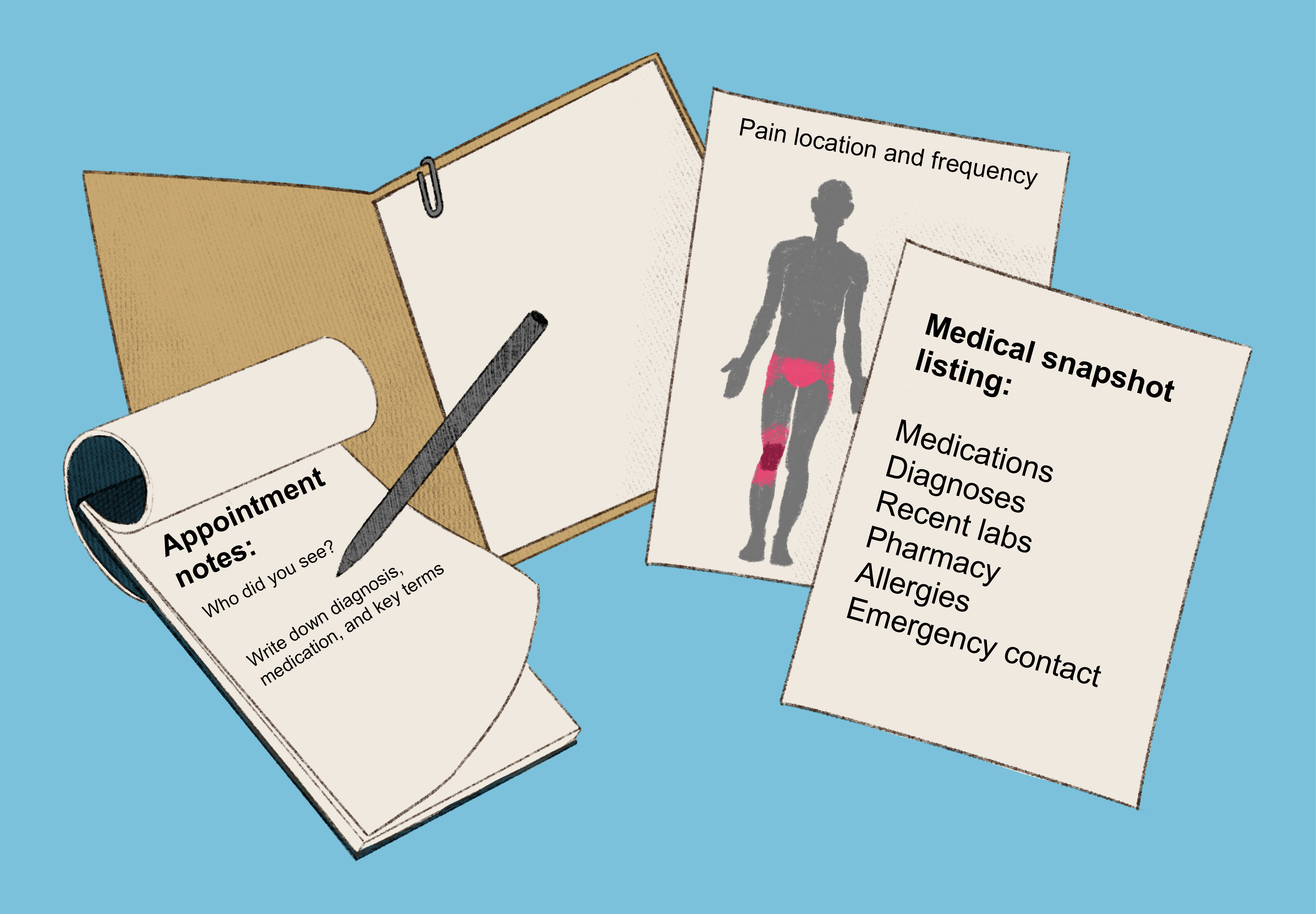
On the caretaker part of it, the person you’re with may not be able to remember everything in that moment to tell the doctor. Let’s say my foot was really sore a week ago or a month ago. They’re not going to think to tell the doctor because it didn’t happen this morning. Writing those things down helps: On this day, I had some really weird foot pain. Stuff that’s not normally something you would experience. And then when you go to the doctor the next time, you have a list of things that you’re like: Oh, maybe I’ll ask the doctor about that. The notebook documents what’s going on for that person. If you have multiple people, there should be a notebook for each one. If you go with your kids, I make a notebook for each child.
One thing I give to my clients is what I call a medical snapshot. It has their medication list—not just prescription medications, also anything over the counter you’re taking: vitamins, herbals, supplements, all that. Then the medical snapshot gives a brief history—current diagnoses, recent surgeries. It could have things like a pain scale. I have a client right now [with] chronic pain, so I have an actual body [sketch] on her medical snapshot, and it’ll indicate what parts of the body are trouble areas at what level, using a pain scale. It could have things like recent labs. It could have imaging. Mental health stuff should be included, as well as what the current pharmacy is. Are they allergic to food or any meds? Emergency contacts; if they have powers of attorney—anything that they would need to know. And we just update it as we go. We try to pick a bright-colored folder, something that says “emergency medical information.”
I always tell other advocates: start with understanding. I always try to listen, because usually if you listen long enough, you kind of start in the middle of someone’s story, and they end up giving you the background that catches you up on where we are and what their disease process has looked like.
MAL: Not everyone will be a patient advocate, but I do think that everyone could develop skills for listening to the people in their lives about the health conditions they have, so they can help advocate and be an empathetic ear. What are good skills for understanding, listening, and asking follow-ups when someone is going through a medical situation?
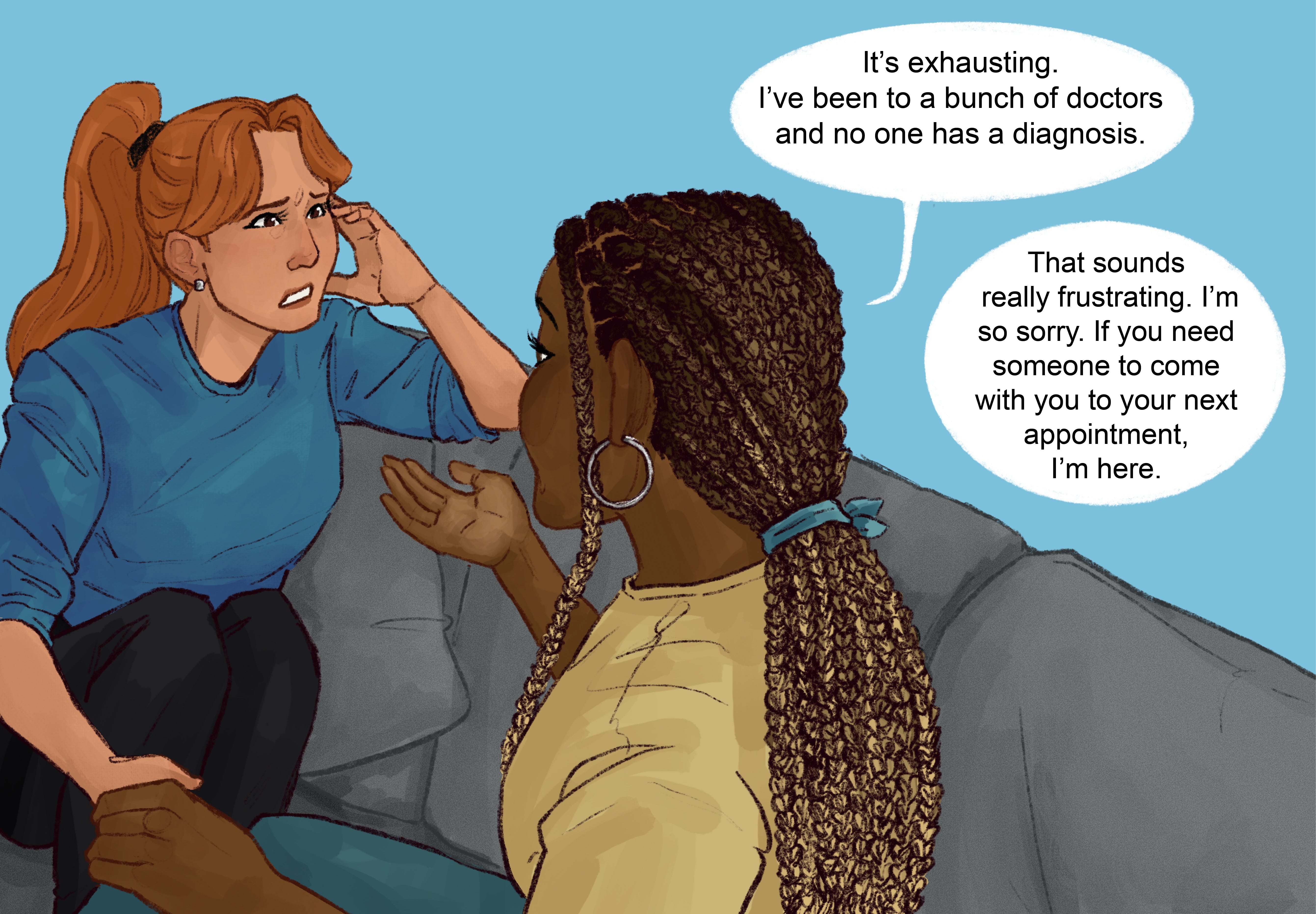
JPD: This is a relationship-building exercise. If we’re making assumptions, that doesn’t help. I think just being open-minded, having empathy, validating people. I think sometimes people just need that. They may not even need an advocate at all, they’re just exhausted. They’re like, This is horrible, being in this position. And then maybe helping them: Hey, you know, that really does suck, I’m sorry to hear that. That doesn’t sound like it’s gone the way that you were hoping. When we’re in a situation of desperation or anxiety, time works very differently for us. Empathy is a huge thing.
MAL: What rights do patients have?
JPD: They have a right to refuse treatment. They have a right to a second opinion. They have a right to make a complaint. Hospitals are supposed to provide them with a handbook with said rights. Even in a clinic, it should be posted somewhere. Typically, there will be verbiage that will say, like, if you want to voice a complaint while you’re here, here’s who you call.
MAL: My understanding is that there are patient advocates that someone can hire individually. There may be folks who exist within the hospital or within the clinic where you’re receiving treatment. There’s also community organizations that people could turn to. If someone wants a patient advocate, what channels would you suggest they go through?
JPD: If they’re in the hospital, I always recommend they ask for someone in the patient relations or patient experience department. If you’re someone on Medicare or Medicaid, you [may] qualify for a community health worker. To hire someone, I would start [with] what’s called a board-certified patient advocate, credential BCPA.

MAL: One of your roles is to help patients evaluate different treatment options. Sometimes in medicine, it’s not black and white, there’s a lot of gray. Maybe you’re helping patients assess opinions of different doctors. What tools do you use to help people navigate medical situations when things might be sort of fuzzy—there isn’t one clear best option?
JPD: It depends on the patient: What is their ultimate end goal? Sometimes there’s different pathways of getting to the same goal. I try to be as open-minded as possible, and a lot of times, it’s thinking outside the box. That’s a conversation with the doctors: Okay, he wants this, this, and this. How do we get close to that? Because I’m guessing we probably can’t get all of that. How close can we get? Which one of these treatments could get us close?
Technology’s always changing. Would that doctor be willing to see if there is an experimental something that maybe could be closer to what this patient is looking for? It’s asking a lot of questions to try to get it down to, Okay, I think I can choose now. And being respectful—that’s their wishes.

Well-Informed: Related stories from the ASU Media Enterprise archives
Robert Cook-Deegan is a physician who has spent decades working in health policy. When he ended up in the emergency department for a blood clot in the brain, he got an inside look at how the barriers to effective, affordable, and accessible care he had long studied actually play out when you’re the patient on the operating table. He writes about the lessons he learned in Issues in Science and Technology.
Well-Versed: Learning resources to go deeper
Interested in becoming a patient advocate? ASU Online outlines the role patient advocates play in the health care system, and the steps you can take to become one.
Well-Read: News we’ve found useful this week
“Baffling. Frustrating. Frightening. What it’s like to be sued over medical debt,” by Katy Golvala, Jenna Carlesso, and Noam N. Levey, June 1, 2026, CT Mirror and KFF Health News
“When should you get a mammogram? Conflicting advice makes it hard to know” by Lauran Neergaard, May 16, 2026, AP News
“Pap smears are designed to screen for cancer. Why are people afraid to get them?” by Shefali Luthra, May 21, 2026, The 19th

Well-Defined: Word of the week
An electrocardiogram (EKG or ECG for short) records the electrical activity in your heart. Typically, electrodes are placed on your arms, legs, and chest using sticky pads. The electrodes send information from your heart through wires onto a computer screen, where your medical team can read and interpret them. On screen, an EKG reading will have short and tall waves and spikes.
EKGs can be performed in an ambulance, hospital, clinic, or doctor’s office. Providers use EKGs to investigate symptoms such as chest pain and shortness of breath, to diagnose heart conditions, and to check your heart after a procedure or heart attack, among other tasks.
-Kitana Ford, health communication assistant
Well-Engaged: What can you do if you’re struggling to afford your energy bill?
An estimated 1 in 20 American households have overdue debt from their utility bills. As temperatures rise and energy bills go up with them, it can be difficult to keep up. If you’re falling behind on your energy bill, or know someone who is, there are resources that can help make heating and cooling bills more affordable. Here are a few:
The Low Income Home Energy Assistance Program is for low income households with higher utility costs. Eligibility, benefits, and application information can be found here.
The Weatherization Assistance Program is for home improvements that can help reduce the cost of energy. You can find more information here.
211 is a program that can help connect you with resources to manage expenses such as utilities.
The National Energy Assistance Referral program can connect you with help at 866-674-6327.
Many energy companies offer financial assistance programs. You can call your energy provider to discuss options.
If your power has been disconnected, find out who to contact for next steps, by state, here.
-Kitana Ford, health communication assistant
Do you have a question or topic you’d like us to ask an expert about? We want to hear from you.
This piece captures something most writing on advocacy misses: the work is not only about helping patients ask better questions, but about protecting a condition that illness often attacks first.
What we call advocacy is, at bottom, the protection of orientation: the patient’s grip on what is happening, what comes next, and what they actually want from it. Medicine has a narrow clinical sense of orientation, person, place, and time, but very little language for the deeper orientation that serious illness can dismantle: the sense of standing somewhere coherent in a world that still holds together.
The cruelty here is structural, not attitudinal. Clinicians often see the fear and confusion clearly. But the architecture around them, consent forms, discharge instructions, the doctrine of the informed decision, is built for someone who arrives with organized records, remembered symptoms, stable preferences, and enough executive bandwidth to compare options. Serious illness, and the stress that travels with it, removes precisely those capacities first.
So advocacy is not a corrective for bad doctors. It is a prosthesis for a structural deficit. A good advocate does not simply preserve autonomy from the outside; they help rebuild the conditions under which something like autonomy can still appear.
And perhaps that is the uncomfortable lesson. Illness does not only take autonomy away. It reveals how much of it was distributed all along.