

Is your community ready for the next climate disaster?
Plus: What’s an “urban heat island” + A climate resilience toolkit

Welcome to Doing Well. Today:
An interview on climate resilience
News we’ve found helpful this week
Word(s) of the week: urban heat island
A toolkit to prepare for extreme weather
Happy Tuesday. Let’s get started!
We Asked: How can we be more climate resilient?
In 2025, there were 23 climate disasters in the U.S. that resulted in more than $1 billion of damage each. Together, they led directly to an estimated 276 deaths. Already this year, there have been five such disasters, which climate change is making more frequent and intense.
This is overwhelming, sad, and scary. But there are things we can do together in our homes, neighborhoods, and cities to be more prepared for the next disaster. To learn more about the changes needed to make our communities more climate resilient, we spoke with Elea Becker Lowe, the program manager for California’s Fifth Climate Change Assessment. Our conversation has been edited for length and clarity.

Short on time? Here’s what to know:
Climate resilience involves understanding and preparing for how climate change can affect you and your community.
Climate change exacerbates extreme heat, drought, and flooding, which all have detrimental impacts on our health. Preparing for these threats in advance helps us stay healthier when they do occur.
If you own a home, there are ways to make it more resilient, like through lawn conversions or energy efficiency upgrades. Public rebate programs can make these changes easier.
If you’re looking to get engaged, think about what your community needs to be more resilient. Then, call your local leaders and representatives to share your priorities.
Make a plan for what you’ll do in case of disaster, including a plan for evacuation. Think ahead of time about the best places to get information in your community.
Mel Moore: What is climate resilience?
Elea Becker Lowe: Climate resilience is the state of readiness to be prepared for the climate shocks ahead of us.
The most important part of being resilient is, first, recognizing: What are the challenges? What do we know the impacts to be? From there we can produce appropriate adaptation responses. Resilience is: How ready are we? Adaptation is: What do we need to do to respond?
MM: Why does climate resilience matter for our health?
EBL: Climate change is impacting health in a variety of ways. One of the most obvious is extreme heat. There’s growing challenges with extreme heat waves—that has so many effects on people’s mental health, physical health, and just overall capacity to move about their day-to-day lives. It can impact our infrastructure, increase energy burden, increase stress on the systems that we rely on. We’re seeing a lot more incidences of heat stroke.
To be more resilient, we can increase shade, increase energy capacity and efficiency for cooling centers or cooling infrastructure in individual residences. There’s a lot of nature-based solutions that help bolster communities against those impacts. There’s interesting work around cool pavement—replacing pavement to help absorb heat.
Drought is another major climate impact. Folks are experiencing drought impacts, one being access to clean, reliable water. That directly impacts their capacity for a healthy, stable way of life. There’s a lot that we can do to provide and improve access, but that’s a huge challenge.
Flooding comes to mind as well. Flooding can displace communities where homes, infrastructure, or roadways are destroyed, and that has a very direct impact on an individual’s well-being and sometimes safety. Also, they can displace toxins, and so that’s another key issue.
MM: When we talk about climate resilience, it seems like there are different actors involved. What can both policymakers and individuals do to promote resilience?
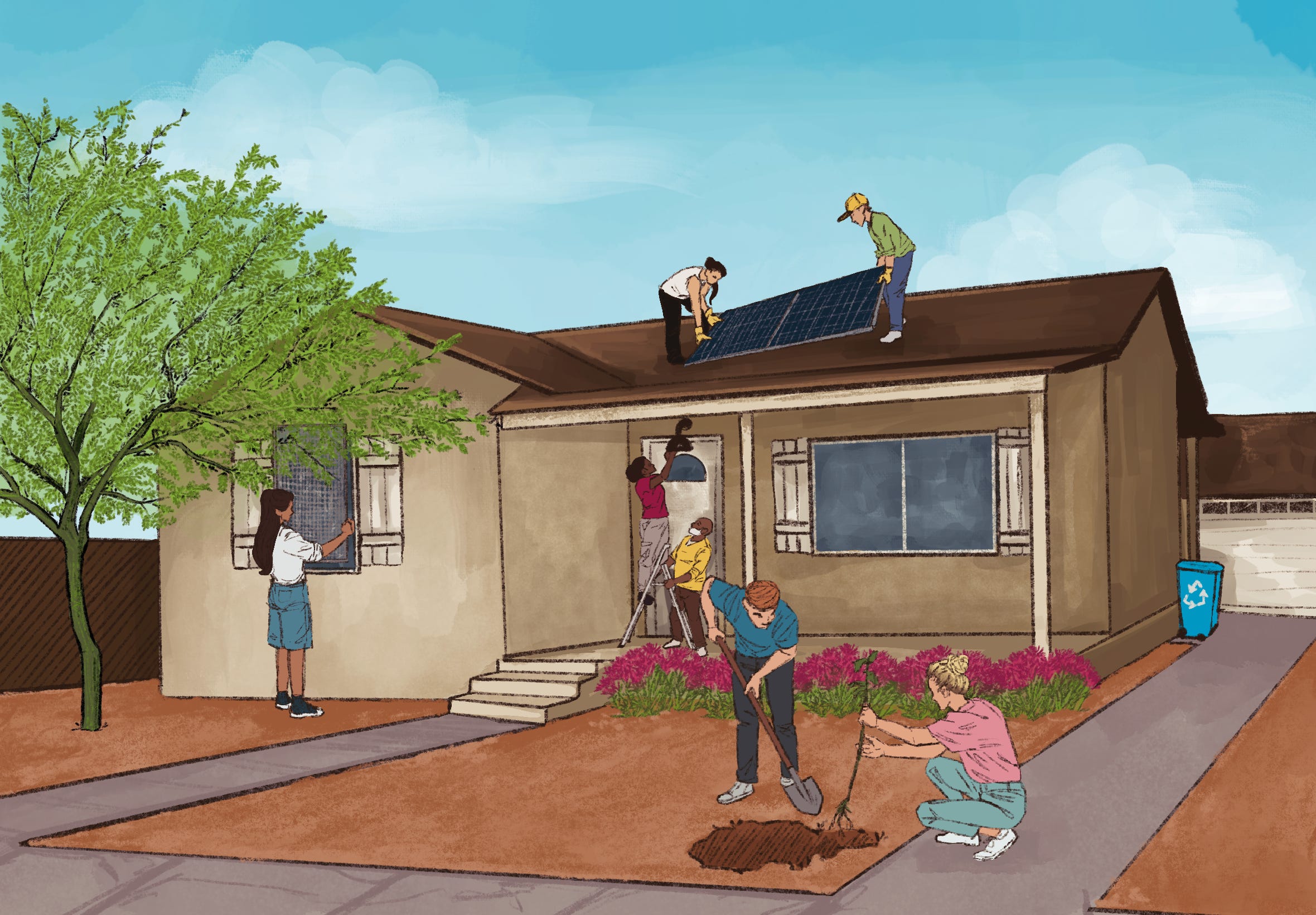
EBL: The burden can’t be directly on the individual. There’s a lot that any individual can do—what the government can do to support that is to install things like rebates and incentives that help folks more easily access programs or new technologies that can make for a more resilient outcome. The city of Sacramento does a rebate program for lawn conversion, for example, which vastly reduces the amount of water that individual residences are using for their lawns. Instead, they’re replacing that with native, drought-tolerant plants. There’s a lot of other programs around retrofitting homes and upgrading energy systems.
MM: You’re working on California’s Fifth Climate Change Assessment. What is the Climate Change Assessment?
EBL: Our goal is to understand what impacts the state will be experiencing due to climate change between now and the end of the century, and then identify adaptation pathways that help us build longer-term resilience to those impacts. How do we foresee the temperature shifts evolving through the years? What do precipitation patterns look like? How does that impact our agricultural production? How does that impact housing? How does that impact our emergency systems? How do we make sense of all this information and answer questions communities have about their resilience goals?
MM: In your experience, what are some of the most effective public policies for climate resilience?
EBL: The most effective approach to resilient public policies is to make climate a lens that we look through across everything that we do. It shouldn’t be a distinct sector.
MM: What are examples of things communities can do to strengthen climate resilience?
EBL: One program that we have creates local hubs that provide direct resources specific to the community, particularly during extreme events. So if and when emergency strikes, folks have this network to go to, to learn updates from, to make informed decisions or to access the resources they need.
MM: As individuals, what can we do?
EBL: Call your local leaders. Call your senators and your representatives, let them know what your priorities are. From a government perspective, we really listen to community priorities, if we know what they are, and if we can hear them.
On the individual level, there’s home retrofits and lawn conversions and replacing your light bulbs—things like that are all contributing to this collective effort to be more resilient long-term. That’s all great, and we should do everything we can to play our individual roles, but it’s also so much bigger than any one person. So really lean into those mechanisms that have capacity to incentivize major structural change.
MM: Part of climate resilience involves thinking about specific disaster risks, like flood, wildfire, heat, and drought. California, for example, has experienced a growing number of wildfires. How can people build resilience against the risk of wildfires if they live in a high-risk area?
EBL: There’s a lot that folks can do to bolster their homes and their properties. Make sure you have multiple access points in and out. Make sure there’s appropriate space between the forest and the home. There’s home hardening techniques to be resilient if and when sparks fly. Make sure that you have access to alert systems and updates, because these things can move really quickly, and it’s important that folks know and have a plan if the time comes to evacuate or to seek shelter.
MM: In Arizona, growing heat is a big concern. I’ve lived here my whole life, and every summer feels hotter than the last. What solutions are there to build heat resilience long-term?
EBL: Urban greening is one of our favorite strategies to reduce some of the urban heat island effect—we’re leveraging the power of plants to absorb some of the heat, to take some of the burden off our energy systems, and to provide refuge for people. There’s a lot of communities that may not be able to access those kinds of resources: workers, unsheltered people. So providing new approaches to working standards, making sure that occupational hazards don’t occur because of heat, or if they do, that we have the appropriate support systems in place to get folks back on their feet, providing those health care services.
MM: We’ve also witnessed a lot of floods in the past few years. How can communities be prepared to stay safe if a flood does happen?
EBL: Similarly, making sure we have the appropriate alert systems in place and folks know where to go or how to access information is really fundamental. When we’re thinking about long-term planning, there’s a lot we can do to build out appropriate emergency capacity: shelters, nature-based solutions that help absorb some of the flood risk, levee systems. But when an event does happen, they’re very destructive. So bolstering the local emergency capacity is really key, making sure folks are aware of what to do. That takes education. Can we leverage bus stops and TikTok and visual representations of the urgent issues folks need to know about, and where to go, and what to do? How can we reach audiences that don’t necessarily want to sift through a report or a pamphlet, what are ways that they would receive information best?
One of the biggest challenges about climate change is though we know that the climate is definitely changing and will continue to change, we don’t know specifically where and when it will hit. We have a good sense of where communities might be most vulnerable, but we can never say with certainty to the day, to the area where an event will strike. So making sure that folks are ready is really key—it’s helping folks make that a priority. Sometimes it’s enough of a burden to just get food on the table, or to put your kids through school. To ask folks to then bolster their home or read up on these different strategies, it may not be realistic. How can these other support networks help to do some of that hard work for them? Make it really easy, make it part of their day-to-day life, so that they have access to the resources they need.
MM: Your job involves thinking deeply about the risks of climate change—that can be really overwhelming. How do you deal with that overwhelm, and are there specific things that give you hope?
EBL: There’s something to be said about climate fatigue and climate burnout and the mental and emotional strain that comes with the doom and gloom of it all. We are on a path for a changing climate, and we need to be realistic about the risks and the challenges ahead of us. But I also see it as an opportunity for innovation and growth. There’s new technologies, there’s interesting ways that different thought leaders are coming together to build a new future, and that’s what I find hope in. We need to grasp it, we need the right systems in place to help.
Well-Informed: Related stories from the ASU Media Enterprise archives
Mitigating and adapting to climate change is no individual endeavor. Read about why collective action is our best way forward in this essay published by Zócalo Public Square.
Plus: Local leaders discuss solutions for extreme heat with Arizona PBS.
Well-Versed: Learning resources to go deeper
Cool pavement—a heat mitigation strategy we discussed in this interview—is already being used on Phoenix roads. In 2020, the city applied cool pavement to several selected areas and partnered with researchers from ASU to study its impacts. Since then, the cool pavement program has expanded. You can find roads with cool pavement in Phoenix on this map.
Well-Read: News we’ve found useful this week
“Staying in a job for the health insurance? About 1 in 4 Americans do, a survey says,” by Joseph Kim, July 22, 2026, NPR
“6 easy ways to move more while working from home,” by Jennifer Heimlich, July 27, 2026, TIME
“There are already more US measles cases this year than in all of 2025,” by Devi Shastri, July 24, 2026, the Associated Press
Well-Defined: Word(s) of the week
The urban heat island effect occurs when a city (or urban area) witnesses warmer temperatures than the surrounding rural areas. This happens because cities have less surface area covered by plants, and instead are full of surfaces that absorb and retain heat, such as cement, brick, asphalt, glass, and steel. Dark surfaces absorb and radiate more heat than lighter materials. On the contrary, rural areas that are covered in greenery can manage heat through a process called transpiration—where plants absorb water through their roots and eventually release it as vapor, acting as a natural air conditioner. To reduce the urban heat island effect, communities can plant more native trees or greenery in urban areas, increase cool surfaces on roofs, roads, and walls, and vary the heights of new buildings to create natural shade.
Well-Engaged: Climate Resilience Toolkit
Looking for tools to promote resilience in your community? This toolkit can help. It provides action-oriented resources for many climate-related issues—including extreme heat, sustainable agriculture, adaptation plans, water supply, and more! If you’re not sure what to search for, you can start by entering your zip code, city, or state here, and the site will populate several issues that have historically affected your area.
Do you have a question or topic you’d like us to ask an expert about? We want to hear from you.