

Get to know the neighborhood inside your gut
Plus: What’s a “proprietary blend”? + How can I eat more fiber?

Welcome to Doing Well! Today:
An interview on the gut microbiome
Health news we’ve found useful this week
Word(s) of the week: proprietary blend
Happy Tuesday. We’re so glad you’re here!
Want to listen instead of read? Download the Substack app to access an audio version of our content.
We Asked: How does the gut microbiome affect our health?
Social media feeds and vitamin aisles alike are full of products that promise to help you improve your gut microbiome. While the gut microbiome plays a powerful role in our health—and research is beginning to shed light on how the balance of microbes that it holds can affect everything from digestion to brain function—it can be hard to separate out the evidence from the sales pitches to figure out what your gut microbiome actually needs.
To sort through it all, we spoke with Corrie Whisner, an associate professor at ASU’s College of Health Solutions whose research focuses on diet, metabolism, and the gut microbiome. She walked us through how stress, nutrition, exercise, and even screen time affect our gut microbiomes and the habits to prioritize to keep them healthy. Our conversation has been edited for length and clarity.
Short on time? Here’s what to know:
Your gut microbiome is made up of bacteria, viruses, archaea, and fungi. It changes as you age, and it can also change in response to nutrition, exercise, and environmental factors.
The gut microbiome is tied to conditions including obesity, metabolic diseases, cardiovascular disease, and mental health.
When talking about gut microbes, it’s useful to remember the three P’s: prebiotics, probiotics and polyphenols. Probiotics are live microorganisms found in food such as yogurt. These microorganisms are good for your gut and help support a varied mix of microbes. Prebiotics are food for our gut microbes, they are found naturally in food like oats, beans, onions, and bananas. Polyphenols are a type of phytonutrient that support gut health. They’re found naturally in bright fruits and vegetables like raspberries and oranges.
Before turning to supplements for pre- or probiotics, see if you can get the nutrient you’re looking for in food. If you do decide to turn to a probiotic or prebiotic supplement, the International Scientific Association for Probiotics and Prebiotics has useful resources on different varieties.
Symptoms of gastrointestinal distress—such as gas, bloating, diarrhea, and constipation—are early signs that something may be amiss with your microbiome, and it’s a good idea to talk to a health care provider.

Kitana Ford: How is the gut microbiome connected to health?
Corrie Whisner: The study of the gut microbiome really started about 20 years ago. With new technologies, we’re learning more and more that the microbiome is connected to everything health related. Originally, the gut microbiome was thought to just affect digestion and absorption in the gut. Now, we know that molecules cross into our blood, they travel to our brain and other organs. Gut microbes can go to breast milk, and then those microbes are transferred to the baby. Everything from obesity to metabolic diseases, cardiovascular disease, mental health—all seem to have connections to gut microbes.
KF: How does our gut microbiome change throughout our lives?
CW: It changes a lot throughout our life. There is much less [microbial] diversity when we’re young, and as we grow into adulthood we have this sort of stable community. As we get older, we start to see changes in what [microbes] are there, what they’re doing, and the total number that are present. This is likely related to the stage of life we’re in and what our bodies need, because we are a partnership. We’re basically a home for these little guys.
Things we can do to change [our gut microbiome] would be modifiable lifestyle factors—like what we eat, exercise, and what medicines or environmental components we’re exposed to.
KF: In your research, you looked at how screen time affects the microbiome. Can you break down those findings?
CW: We were looking at college students specifically. When you’re in your first year of college, you’re moving away from home and starting to embody your own behaviors and habits. In the modern world, we all spend so much time in front of a screen. We wanted to see screen time, self-reported physical activity, and different aspects of dietary intake around fiber consumption, which we know is an important food for microbes. In a generally healthy adult population, we want higher microbial diversity. We found that those with less screen time had greater diversity than those who had more screen time.
KF: What are probiotics and prebiotics, and how important are they in supporting the microbiome?
CW: If you think about our digestive tract as a tube that allows us to interact with the external world, our microbes then are exposed to everything we consume. I think of three P’s that our microbes like—prebiotics and probiotics, and then polyphenols. We can start with probiotics: These are live microorganisms that we consume. If you’ve ever eaten yogurt, that’s a fermented product, so you’re eating lactobacillus or bifidobacteria strains that are used to ferment that product. Those are like little friends for your microbes, so it’s other little buddies coming in to join that community. That’s like putting a kiddo on a school bus to go to school. You wouldn’t want to send them without a lunch: Prebiotics and polyphenols are the food for those probiotics you’re sending in, and then also your own gut microbes.
Prebiotics are mostly carbohydrates, things like dietary fibers. There are naturally occurring ones and man-made ones. They’re basically food that we can’t digest, but our microbes can. When they digest them, they make healthy things like short-chain fatty acids, which promote intestinal and systemic health. They can lower blood pressure.
Polyphenols are pigments that come in foods that we eat. Think of really bright raspberries or strawberries, those bright reds, orange, green, yellow—all of those have anti-inflammatory properties. There are polyphenols in soy that microbes can convert into health-beneficial molecules.

KF: Are supplements necessary for a healthy gut microbiome?
CW: I always opt for a food-first approach, one, because it’s more affordable, and two, nature made every food in a way that delivers often multiples of these things all at once. When you typically get a supplement, you have a very refined and concentrated amount of a single molecule or nutrient. Supplements can also be expensive, so if there’s an opportunity to get food sources, you’re going to get all the vitamins and minerals and other goodness that comes with it, and it’s probably cheaper in the long run.
KF: There are a lot of ads and influencers that market supplements to boost your gut microbiome. How should we evaluate those messages?
CW: See if they’ve cited studies so that you can dig a little deeper. If someone’s claiming that something works and they’re selling it, be a bit apprehensive at first. Show me the data, or Can you provide references or resources? If they don’t have them, or if they’re only testimonials, those are times where, for me, a little light bulb goes off: I don’t know, maybe that’s not the right thing.

KF: What is one thing someone can do every day to support their gut microbiome?
CW: Love your dietary fiber foods. There are so many amazing foods with great dietary fiber content and polyphenols. I usually tell people, start with berries, because you get the best of both worlds, and most people enjoy berries. It’s important to remember that dietary fiber is enriched in most of our grains, and they provide some of the most diverse types of fibers that you wouldn’t get from vegetables and fruits.
KF: How can we tell if we have a healthy gut microbiome? Are there any signs or symptoms that indicate we might have an unhealthy gut microbiome?
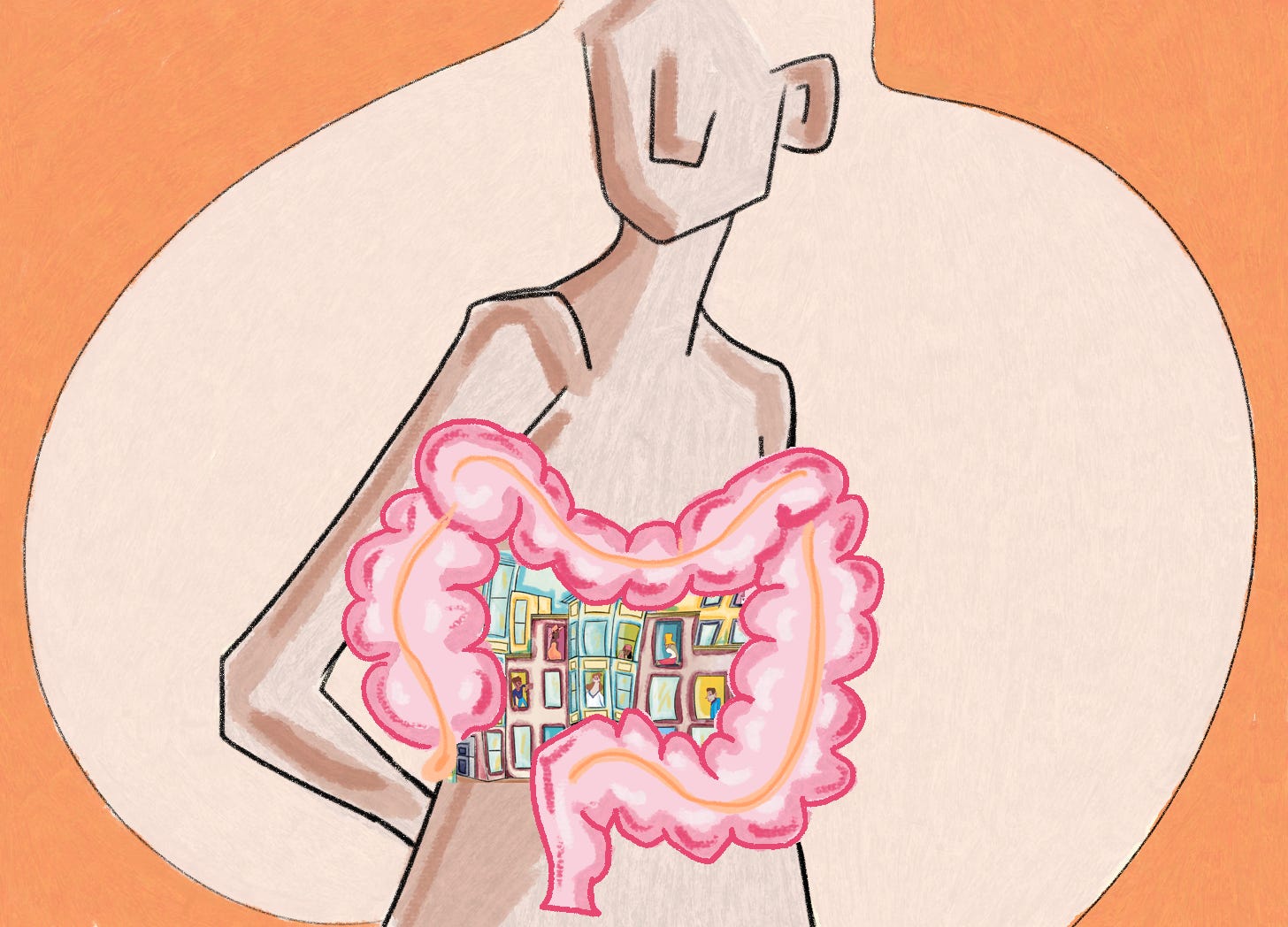
CW: In some ways, it can be hard to tell if we have a perfectly healthy microbiome. I think of it as a community, like a neighborhood. For example, you may have a couple neighbors that live next to you that you love and adore, and you all share, help each other, and enjoy chatting. Then you have a grumpy neighbor across the street, and everyone’s like, Oh, Frank, he’s so difficult. But there’s so many good people in your neighborhood that you can all kind of just not be bothered by Frank, and laugh it off when he does crazy things. In some ways, our microbiome is like that. Because we all have pathogens present—we all have beneficial and opportunistic microbes. Sometimes they can be good, sometimes they can be bad. It’s balance that matters. They’re all responding and doing things around one another.

GI distress—gas, bloating, diarrhea, constipation—those are some early signs that there could be a microbiome problem. If you feel otherwise healthy, it’s probably doing its job. You probably still have some bad guys in there, and that’s okay, because they’re just there to keep everyone else in check and on their toes.
KF: What are the most common gut microbiome myths you see?
CW: Something that I get concerned about is when people instantly push supplements, whether it’s a probiotic or a prebiotic. It doesn’t actually fix the underlying issue that’s there. It’s probably just putting a band-aid on it. If we all went to dietary approaches first, or making sure we take care of ourselves socially, emotionally, physically, we wouldn’t have to worry about needing those things.
The message should be: What’s going on in your life? Let’s see what is a viable option for your lived experience. If you live in an unsafe neighborhood, telling you to go out for walks every day is not going to work. But maybe you are able to get fresh produce at the store, and that works, so that could be an option. Pulling the levers that you have available, that are sustainable financially and correct the underlying issue, rather than masking it.

Well-Informed: Related stories from the ASU Media Enterprise archives
How is the gut microbiome connected to the brain? In this segment on Catalyst from Arizona PBS, ASU researchers discuss how they’re studying the link between gut microbes and symptoms of autism spectrum disorder.
Well-Versed: Learning resources to go deeper
Still have questions about how the gut microbiome affects your overall health? Check out this session of Health Talks from ASU’s College of Health Solutions for a deep-dive.

Well-Read: News we’ve found useful this week
“People have been fermenting food for millennia. Here’s why more people are focused on gut health now,” by Devi Shastri and Mary Conlon, July 11, 2026, The Associated Press
“Are omega-3 supplements actually good for your brain?,” by Dana G. Smith, July 8, 2026, The New York Times
“Fast walkers in their 80s cut their risk of cognitive decline by half, a study finds,” by Allison Aubrey, July 6, 2026, NPR
Well-Defined: Word of the week
Have you ever seen a supplement labeled as a “proprietary blend”? A proprietary blend is a term on product labels used to describe the ingredients in nutritional supplements, without exposing the exact “formula” or amounts of each ingredient. The term comes from the Dietary Supplement Health and Education Act of 1994, which allows for broad discretion in brand marketing. Proprietary blends often have names such as “superfood complex” or “greens blend,” which may give the consumer an impression that its contents may be more potent than the actual ingredients suggest—legal regulations do not require manufacturers to list the specific amount of each ingredient.
The FDA requires supplement manufacturers to inform consumers of the weight of the proprietary blend, and to list the components of that blend in descending order by quantity. In order to understand what is actually in these blends, take note of the order of ingredients—if an ingredient that you want a greater amount of is near the end of the list, that supplement may not have a high quantity of it. Likewise, if a blend lists a lot of different ingredients but doesn’t weigh very much, it may not have a sufficient amount of each ingredient to be effective.
-Mel Moore, senior health communication assistant
Well-Engaged: How to get more fiber
It can be hard to know how much fiber you really need, and which foods are a good source of fiber.
To make sure you’re hitting your fiber goals, keep these daily fiber recommendations in mind:
21 grams for women older than 50
25 grams for women 50 or younger
30 grams for men older than 50
38 grams for men 50 or younger
With these high-fiber recipes, getting enough fiber doesn’t have to be a challenge—fiber can be found in a cookies and cream shake, breakfast burrito, artichoke dip, and chili.
Do you have a question or topic you’d like us to ask an expert about? We want to hear from you.